Private pilot routes · measured July 2026

MFabric Enterprise.

Put repeated long-context work on a faster cost curve.

MFabric's deployable Qwen3.6-27B route served 128 repeated 32K jobs at 382.9 aggregate tokens per second through authenticated HTTP. On a separate 262K H200 stress row, it reached 299.2 aggregate tok/s at c64. Every admitted output matched exact; unsupported work returns to the normal exact path.

● measured on GB10 and H200 · ● exact output · ● private deployment
382.9aggregate tok/s through the service
299.2aggregate tok/s at 262K / c64
c82 / c83shared-prefix pass / H200 OOM
Measured performance

Same host. Same model. Same submitted long-context job.

The comparison below uses one bounded repeated-prefix contract: Qwen3.6-27B on an NVIDIA GB10, 128 submitted rows, 32,768 prompt tokens per row, and eight exact generated tokens per row. MFabric used a prepared resident route; the external engines used their native BF16 prefix-cache paths.

Qwen3.6-27B32,768-token promptsc128 submission1,024 timed output tokensexact-token match

Hot aggregate output throughput

tok/s · linear scale
MFabric resident route392.86
SGLang 0.5.1424.24
vLLM 0.24.04.67
Hot replay after route-specific preparation or first admission. All 128 completed rows matched the canonical exact tokens. MFabric recorded zero native fallbacks. The eight 32K prefixes were repeated sixteen times; this is not an arbitrary-prompt comparison.
H200 long-context stress

At 262K, measure resident work separately from queued work.

This comparison uses one H200, Qwen3.6-27B, identical 262,136-token prompt IDs, the same exact greedy token sequence, and eight cached decode transitions per request. The prompt is shared within each submitted batch.

Qwen3.6-27BNVIDIA H200262,136-token promptc64exact-token match

262K / c64 hot decode throughput

tok/s · linear scale
MFabric shared-prefix route299.23
SGLang 0.5.1489.75
vLLM 0.24.041.83
Hot decode excludes prefill. MFabric used three timing repeats; the external saturation rows used one. All three runtimes produced the same exact token sequence. This is a repeated-prefix workload, not arbitrary 262K chat.
82 MFabric shared-prefix states Physically resident and exact at c82; the next row, c83, produced a measured CUDA OOM. Unique-prefix capacity was not measured.
4 vLLM full independent 262K contexts Live KV-pool telemetry reported 1,216,937 tokens, enough for four full contexts before the scheduler must queue work.
2 SGLang full independent 262K contexts Live pool telemetry reported 687,497 tokens, enough for two full contexts before the scheduler must queue work.

vLLM and SGLang both completed c1024 repeated-prefix submissions by wave-scheduling queues larger than their resident pools; neither engine OOMed on that queued workload. The 4 and 2 figures are initialized full-context pool capacity, not observed request-failure counts.

GPU economics

Save the memory before buying another card.

On the same measured route, MFabric reduced resident K/V and recurrent state while executing less selected work. The dense c128 state control was OOM-killed on the same 128 GB host; the admitted service completed.

That is the commercial wedge: fit and serve a repeated long-context fleet on hardware where the dense shape cannot stay resident.

MFabric share of exact-route footprint

exact baseline = 100%
Resident K/V
11.34x less
Recurrent state
7.32x less
Selected work
2.60x less
MFabric measured shareremaining track = exact baseline
Resident reduction is a measured capacity result, not a guaranteed invoice reduction. A customer pilot converts it into cost per accepted result on the customer's workload.
What it is

A specialized lane beside your general serving stack.

vLLM and SGLang are strong general-purpose engines. MFabric is not trying to replace them for every prompt. It identifies expensive repeated workload shapes, prepares a private resident lane for those shapes, and leaves dynamic or unsupported work on the exact serving path.

01 / FAST LANES

Repeated context becomes resident

Stable manuals, research sets, policy libraries, and other repeated corpora can be prepared once, integrity-bound, and served as a resident campaign instead of rebuilt for every request.

02 / FAILS CLOSED

Unproven work takes the safe path

If a request does not match the admitted artifact, batch, model, or quality receipt, MFabric signals the outer router to use exact/default. It does not silently stretch the claim.

03 / PRICED ON OUTCOMES

Cost per accepted result

A pilot measures throughput, memory, fallbacks, tail latency, and exact output together. The buying decision is based on the GPU cost of answers you can actually use.

Research case study

From a 37-run metagenomic campaign to a lab-ready hypothesis.

MFabric coordinated an outcome-blind, resumable evidence campaign while exact alignment remained the authority for every biological count. The result is a falsifiable Ara h 2 sequential-cleavage hypothesis and two role-separated packets a qualified lab can execute independently.

What the runtime changed

Accelerate the repeated extraction work. Keep the scientific controls.

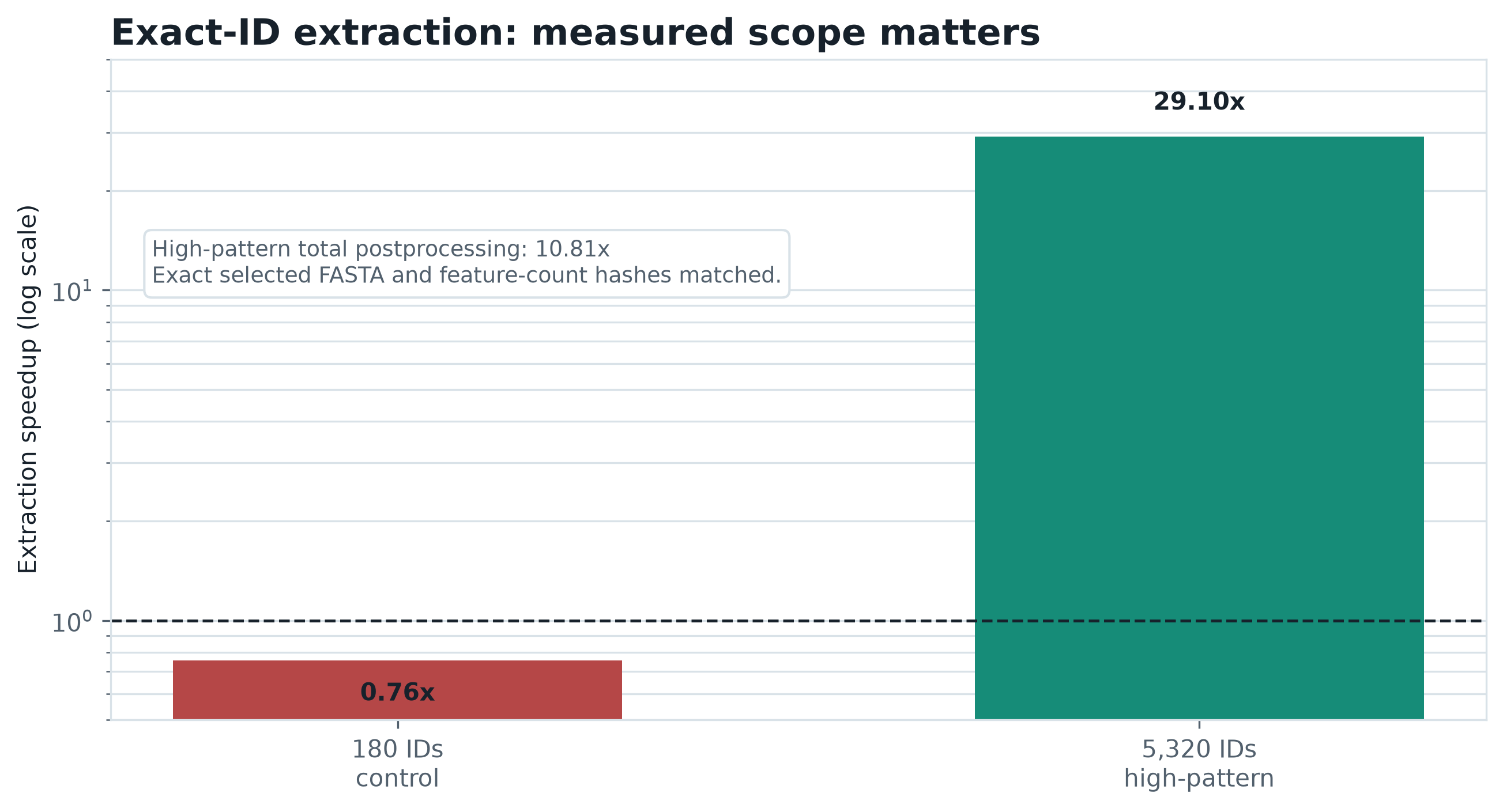
On one public high-pattern metagenomic row, exact-identifier extraction fell from 9,153.7 seconds to 314.6 seconds. Total post-processing fell from 9,457.0 seconds to 875.2 seconds, with identical output and hashes.

29.10xexact-ID extraction speedup
10.81xtotal post-processing speedup
0.76xlow-pattern control, not promoted
Exactoutput and hash parity

Campaign output: two sequence-valid cleavage branches, four coequal candidate enzyme pairs, exact molecular readouts, and a blinded 393-sample Stage A/B validation design. No enzyme activity, reduced allergenicity, treatment effect, or clinical safety has been demonstrated.

Log-scale chart showing 0.76x low-pattern and 29.10x high-pattern exact-ID extraction speedups, with 10.81x high-pattern total post-processing speedup
The high-pattern row accelerated materially; the low-pattern row did not. MFabric retained that negative control instead of turning a bounded optimization into a universal claim. The public release includes source tables, checksums, protocol, and separate coordinator and analyst archives.
Where it fits

Use MFabric for the repeated fleet. Keep a general engine for the open world.

This is a complementary serving architecture. The measured resident lane handles an admitted repeated-prefix campaign; exact/default remains the route for arbitrary or changing prompts.

DecisionMFabric EnterpriseSGLangvLLM
Primary fit Admitted repeated long-context fleets General high-performance serving General high-throughput serving
Measured 32K/c128 row 392.86 aggregate tok/s 24.24 aggregate tok/s 4.67 aggregate tok/s
c128 execution observed One resident 128-row graph Submission completed; graphs observed through batch 33 Submission completed through queued/wave execution
Quality on measured row 128/128 exact, zero native fallback 128/128 exact 128/128 exact
Outside admitted scope Reroute to exact/default Continue on general engine Continue on general engine

The external c128 submissions used repeated-prefix caching and queued/wave behavior; neither receipt proved 128 unique resident 32K contexts. This table describes the July 2026 GB10 measurement, not universal engine performance.

Proof ledger

One deployable route, plus two additional economic lanes.

The promoted 27B service is the current enterprise wedge. The structured-packet and 64K capacity receipts remain available where their narrower workload contracts fit.

Fast lane · small structured requests
49.9 us p50

For one bounded structured request shape, the managed private lane returned a result in about 50 microseconds at the median without a model-provider call.

What it means: high-volume deterministic work can bypass model-serving overhead when the request matches the admitted packet.
62,528successful responses
0errors
0model-provider calls
512queue depth tested

Boundary: a bounded active-packet workload, not general generation or broad serving-engine superiority.

Capacity · 64K long-context work
53.5x floor

On a 64K long-context workload, the capacity-adjusted cost per accepted result hit a 53.5x floor — the saving comes from how much work the GPU absorbs under concurrency, not single-request speed. Tail latency stayed within 1.16x and output throughput held at 0.87x.

What it means: you pack far more long-context jobs onto the same card, while latency barely moves.
c2 / c4 / c8admitted concurrency
c1routed to exact/default
1.16xmax p99 arrival penalty
0.87xmin output TPS ratio

Boundary: not a single-request latency speedup, an invoice-cost guarantee, a public SLA, a product-default route, or universal runtime superiority.

Boundary

What this page does not claim.

Every number above is bounded to its named workload shape. The comparison supports superiority on one repeated-prefix contract, not a universal engine ranking. Anything unsupported, changed, or unmeasured routes to exact/default.

Design partners

Bring one repeated workload that is expensive today.

The fastest path to value is not a broad platform migration. It is one repeated long-context fleet with enough concurrency to make memory residency and weight reuse matter. We prepare it, prove exact output, and price the result on your hardware.

A strong first workload

  • Uses a stable model and repeated 16K-32K source sets.
  • Runs many similar requests at the same time.
  • Has an exact or accepted-answer comparator.
  • Pays materially for K/V residency or queue saturation.
  • Can keep the service private and resident.

What the pilot returns

A private proof packet binds the admitted workload, artifacts, fallback rule, exact-output result, throughput, memory, and tail latency. It ends with a deploy/no-deploy decision for that lane.

cost per accepted result
fallback count
p50 / p95 / p99
redacted lane telemetry
Coming soon to Enterprise

Governed write access for AI agents.

Agents are only useful when they can change things — and nobody wants to hand them credentials. Our next enterprise product is the layer between: the agent never holds write credentials. It proposes a structured change pinned to the exact state it read; the target gateway validates the change in a staging twin, admits or rejects it — never silently repairs it — then applies it and verifies the fields it owns. The proved non-enterprise work includes byte-exact rollback of a governed projection and machine-checkable receipts on the exercised paths. The complete signed chain and independent auditor verifier are in build, designed to support SOC 2 change-management evidence rather than establish compliance. A pinned model-admission policy has also passed in one simulator embodiment; that is not a universal model ranking or a Kubernetes claim. Patent pending.

90-second demo in a controlled procedural test world: a pinned proposal admitted through five checks, a direct edit refused with state unchanged, and a verified reverse restore to the recorded pre-change state. Presentation pacing is disclosed on screen; no live AI authorship is depicted.